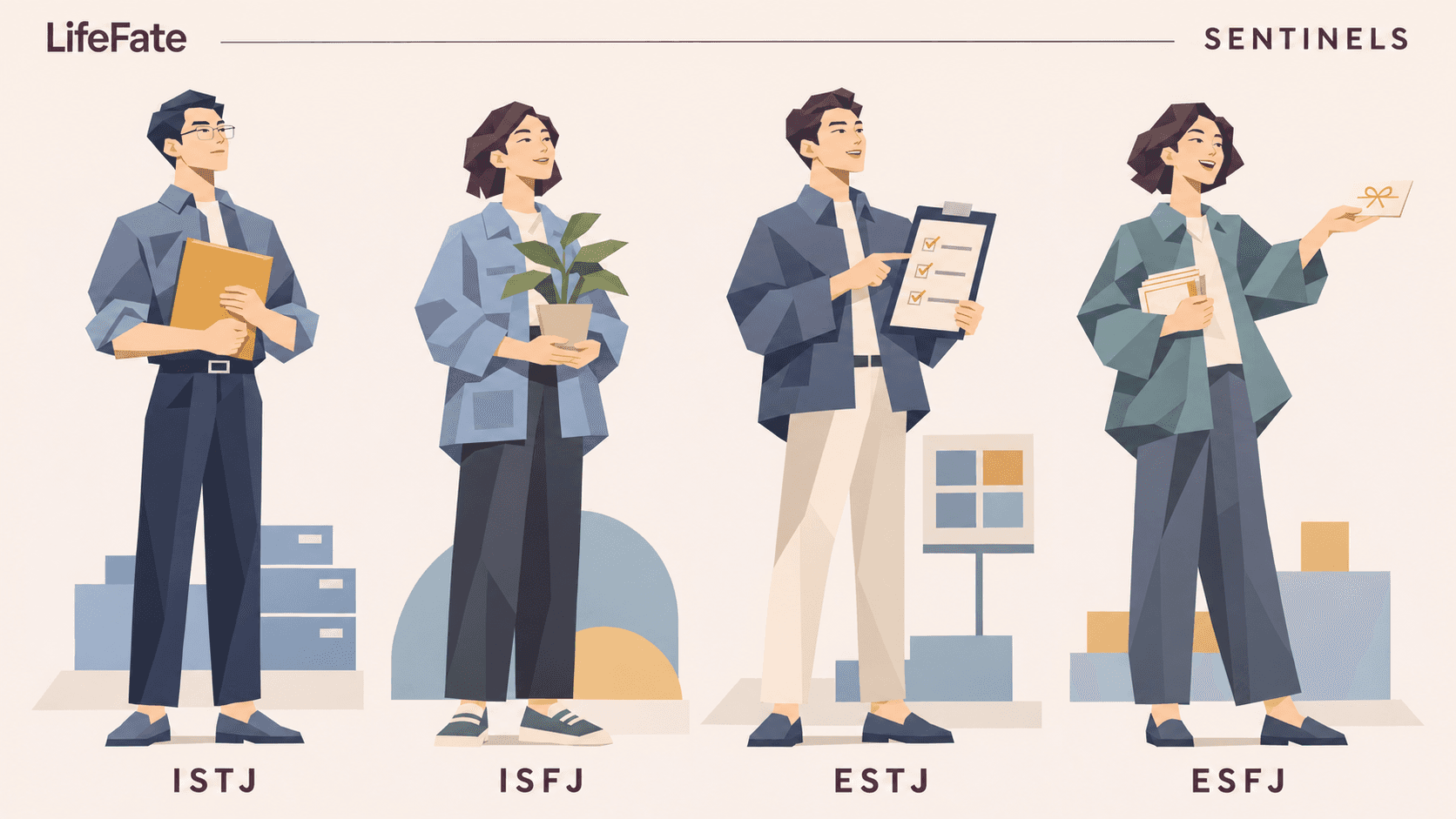
Practical Leader
You organize what needs doing and make sure everyone knows their part.
ESTJ patterns
Making decisions
You look at the goal, resources and responsibility. Once those are clear, you decide; leaving matters unsettled is uncomfortable. Changing your mind is possible when a proposed alternative makes better sense than the current plan.
Relating to others
You speak directly and mean to address the issue rather than the person, a distinction that may be clearer to you than to the listener. Care becomes action: clearing a path or bringing resources over, rather than circling around reassuring words.
At work
Turning a loose group into a team with roles, deadlines and handovers is a strength. The challenge is work that has not yet taken shape. When direction remains open, the instinct to push forward can close off possibilities too soon.
When demands pile up
The busier you become, the more you take over, bringing others' tasks onto your own desk to finish them. You end up more exhausted, while everyone else becomes less sure how to help.
A practice to develop
Distinguish 'this way is faster' from 'it has to be done this way.' You usually mean the first, although the words others hear often express the second.
A common misunderstanding
Being controlling is a common interpretation. Underneath it is a concrete sense of responsibility: when something goes wrong, you are prepared to step forward.
Position in the zodiac
Where your four preferences fall
EExtraversion
Direction of attention · JungYou think while speaking. More people and activity can sharpen your attention, and an idea takes shape as you say it.
SSensing
Taking in information · JungYou first notice concrete details: numbers, order, physical feel and what happened last time.
TThinking
Making judgments · JungYou first ask whether the reasoning works: its premises, causes and effects, and possible contradictions.
JJudging
Which function faces outward · MyersYour judging standard faces outward, so other people first notice your decisions and deadlines.
The fourth pair is an indicator rather than another independent quality: of the judging and perceiving functions, which do you direct toward the outside world? It points to those two earlier pairs rather than adding a new description of you. Drawing it as a fourth scale alongside the first three treats an indicator as though it were a separate quality being measured.
The two leading functions
This type leads with Extraverted Thinking, supported by Introverted Sensing. The traditional model also describes third and fourth functions, but schools disagree about their attitudes, so we do not assign either here.
Neighboring and opposite types
The four types that differ by just one preference often read more differently than expected. Changing one preference also changes several connected patterns:
- ISTJ
One preference differs: Direction of attention (Extraversion → Introversion)
- ENTJ
One preference differs: Taking in information (Sensing → Intuition)
- ESFJ
One preference differs: Making judgments (Thinking → Feeling)
- ESTP
One preference differs: Which function faces outward (Judging → Perceiving)
Opposite on all four pairs — INFP
Your inner values are difficult to shake, even when nothing about your appearance seems forceful.
Frequently Asked Questions
- What do the four letters in ESTJ mean?
- E means Extraversion (Direction of attention); S means Sensing (Taking in information); T means Thinking (Making judgments); J means Judging (Which function faces outward). The first three pairs come from Jung's 1921 book; the fourth was added by Myers. We make this distinction because all four are often incorrectly attributed to Jung.
- Does the final J in ESTJ describe how organized I am?
- No. It indicates which function faces outward rather than measuring tidiness, as explained under Where your four preferences fall. Organization can be a consequence, but it is not the definition. Someone can be disorganized in an area they do not care about without changing their preference. Defining the preference by its consequences would give different answers for the same person in different settings.
- Is the most visible side of ESTJ also its central pattern?
- Yes. This type's outward-facing function is also its central one, so new acquaintances and long-time friends will often describe similar patterns. For half of the sixteen types, this is not the case; their guides explain the distinction.
- Are ESTJ and INFP opposites?
- All four preferences differ, which makes the types a useful contrast. Opposite preferences do not mean incompatibility. The two types value different things and approach the same situation from different ends, often filling gaps for one another when working together. The Neighboring and opposite types section introduces INFP, with a link to its full guide.
- Can this site identify my type?
- We do not use an existing 16 Types questionnaire. We reviewed scales with openly available questions and scoring, but none met our requirements for commercial use because of licensing, trademark restrictions or a different underlying construct. Our self-assessment questions are written by this site, with published scoring, and have not undergone validation research. If you obtained your four letters elsewhere, you can still use these descriptions for comparison.
These tools are not psychological counseling, mental health diagnosis or treatment advice. The questionnaires interpret your own answers, the birth chart uses your birth time and place, and tarot uses randomly drawn cards. None is a clinical assessment. If emotional distress persists or affects everyday life, seek a registered psychologist, psychiatrist or local mental health service.
Take a 16 Types self-assessment
This page explains the four preference pairs and each type's habitual patterns without requiring you to enter anything. To explore your own four letters, preference scales and personal profile, answer the questions on the 16 Types page. The assessment is self-authored, has not undergone validation research, and keeps your answers in your browser.
Each rule is traced to a checkable source. Where schools differ, we identify them and state which interpretation we use. The relevant distinction is the school followed, rather than a claim that one interpretation is a calculation error.
- Type interpretations
The four dimensions and sixteen type names come from publicly available literature, with sources identified individually. None of the existing questionnaires we reviewed could be adopted, so our questions are self-authored and have not undergone validation research, as stated on the page.